
 Klein Technique™ with Barbara Mahler : a choreographer, performer, movement educator, body worker; a master teacher of and major contributor to Klein Technique™, faculty and certified practitioner of Zero Balancing.
Classes, Performances and Workshops Klein Technique™ w Barbara Mahler
Studying 1977-present, teaching 1983-present; continually involved in development, outreach, and application. I am a major contributor in the development and outreach of the work.On occasion I have been notes as a “champion” of the work.
Klein Technique,™ is a living and growing body of work initially developed by Susan Klein in the mid 70’s, originally a response to the formal dance training available at that time. It has continued to develop, becoming a source of information, and empowerment for dancers of all styles, its ultimate goal being increased coordination, facility and the lessening/prevention of injury. Process oriented, its a path for dancers to find their own essence, identity and integrity and take that into movement. Her mentors, and greatest influences were Steffi Nossen, Martha Graham, May O’Donnell, Gertrude Shure, Don Farnworth, Colette Barry, Dr. Barbara Vedder, D.C., Irmgard Bartenieff, Dr. Fritz Smith, M.D., Dr. J. R. Worsley, D. Ac. Many others taught her invaluable lessons; something to push against to spark change.
Klein Technique is a body of work, concise and yet continually evolving. The main thrust of the work is for dancers to find their own essence, identity and integrity and take that into movement. In order to do that we work at the level of the bone, not the traditional level of the muscles. Klein Technique is not a release technique in that our goal is not to release, but to move. In order to move most efficiently it is necessary to release or let go of the muscles that hold us back from moving ,and fix the body and the mind into set and locked configurations. When the bones are aligned we become connected, we become powerful and strong. The body becomes efficient and alive, and injuries often heal.
We work to align the bones by using the deep muscle groups in the pelvis that are responsible for the transfer of forces through the body – the psoas, the hamstrings (connecting sitz bones to heels), the pelvic floor to find the deep support between the tail and the pubic bone, and the external rotators. Of of these work to bring the pelvis upright on top of the legs, bringing us into better alignment with the forces of gravity. We work to find a fluid “placement” that is ever evolving. We do not work to “exercise” these muscle but rather work to “wake them up”; and learn to use them for support and realignment of the bones. We work towards, and teach the body to be elastic, responsive, open to choices, and expressive. Most importantly, the body does not exist alone but in connection to the ground, the space, and to others.
Classes (and workshops) focus on and provide the tools to support movement of all styles of dance as well as other activities. The purpose of the “stretch and placement” class is to re-educate one’s body with an interweaving of theory and practice on a physical, intellectual, and organic level. The result is a clarity and sureness of movement, and a new level of understanding the innate intelligence of the body. The work has many facets and levels. It is a way to explore one’s capacity to move, bringing insight into the workings of one’s body. It increases efficiency, facility, and can increase the longevity of one’s dancing life. Non-stylized, it’s embodiment creates possibilities – greater technical facility, fluidity, and grounded -ness. It manifests itself in the creative capacity by releasing the constrictions of the body and mind from the configurations of right and wrong, helping to replace older patterns of movement and thinking with newer, more efficient ones. From this place of possibility and openness comes a wealth of options we often overlook.
Classes are not restricted to dancers but open to anyone who wants to achieve greater efficiency in their movement and freedom within their body. We break down movement into its simple component parts- analyzing, refining, re-educating. We work with the psoas group for deep support, the connection between the tail and pubic bone, the external rotators, and the hamstrings/sitz bones to heels. We drop under the level of the superficial muscles, and build our center from the inside out.
Here, in the ongoing classes, space is created for all to work, to learn, and to be. In workshops, it is the time and the group energy that moves us along quicker,-dropping us all, participants and teachers, into an escalated learning experience.
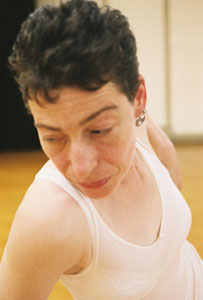

 Barbara Mahler
Pingback: Movers & Shapers: Tiffany Mills - The Moving Architects
Pingback: Dansfilm och dans via appar och telefoner | Bloggen Om Dans
Pingback: Rising, Walking, Reaching | Zipporah Dance